
The Best Fluffy Pancakes recipe you will fall in love with. Full of tips and tricks to help you make the best pancakes.



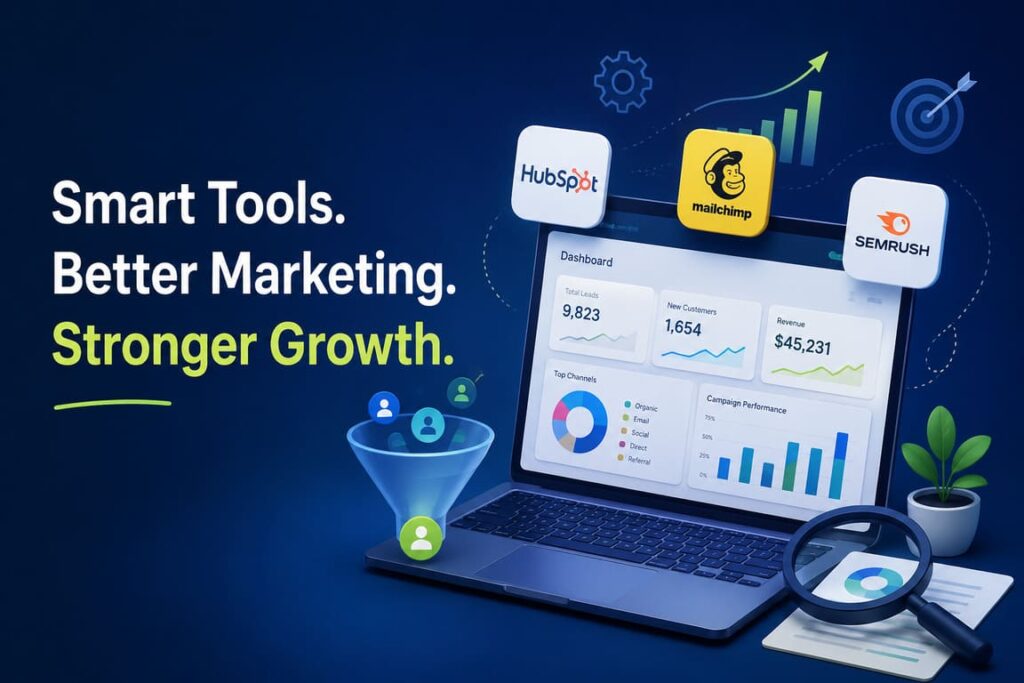
If you want one short answer, the best product marketing tool for most businesses is a CRM with built-in marketing automation. In practice, that usually means a platform like HubSpot as the core system, with specialist tools like Semrush for search demand and Mailchimp for email automation depending on your budget and setup.
Why? Because product marketing is not one job. You need to:
- understand demand,
- position the product,
- capture leads,
- educate buyers,
- follow up automatically,
- and measure what actually converts.
A single tool that connects customer data, campaigns, and reporting saves time and usually produces better decisions than a stack of disconnected apps.
This article explains:
- which product marketing tool is best overall,
- when other tools are better,
- why these tools work,
- how beginners can use them,
- and what real companies achieved with them.
The short verdict
Best overall product marketing tool: HubSpot
Best for: B2B, SaaS, service businesses, and growth-stage teams that want one system for CRM, email, forms, automation, lead nurturing, and reporting.
Best email-focused product marketing tool: Mailchimp
Best for: ecommerce brands, lean teams, and beginners who want fast email automation and segmentation.
Best discovery and SEO product marketing tool: Semrush
Best for: teams that need to find demand, research competitors, build SEO content, and grow organic traffic.
Best measurement layer: Analytics + first-party data stack
This is not one brand recommendation. It is a reminder that measurement is mandatory. According to Salesforce, 88% of marketers use analytics or measurement tools, 86% use CRM systems, and 84% use first-party data. Source
Why CRM + automation is usually the best answer
A product marketing tool works best when it helps you do three things well:
- Collect buyer signals
- form fills
- email opens
- demo requests
- page visits
- product interest
- Turn signals into actions
- send nurture emails
- segment audiences
- trigger sales follow-up
- personalize content
- Measure revenue impact
- leads created
- conversion rate
- deal progression
- repeat purchases
- campaign ROI
That is why all-in-one systems win so often. They reduce friction between marketing, sales, and reporting.
Salesforce’s marketing statistics page supports this direction: 63% of marketers are already using generative AI, 86% use CRM systems, and only 31% are fully satisfied with their data unification ability. That last number matters. Most teams do not fail because they lack channels. They fail because their tools do not work together. Source
Table 1: Best product marketing tools by real use case
| Tool | Best for | Why it works | Main strength | Beginner first step |
|---|---|---|---|---|
| HubSpot | B2B, SaaS, agencies, service businesses | Combines CRM, forms, email, workflows, and reporting in one place | Strong all-in-one execution | Create one lead capture form and one automated follow-up sequence |
| Mailchimp | Ecommerce, small businesses, creator brands | Easy email automation, segmentation, Shopify integrations, revenue tracking | Fast setup for lifecycle email | Build a welcome flow and cart-abandonment flow |
| Semrush | SEO-led growth, category creation, competitor research | Helps teams find keywords, content gaps, and traffic opportunities | Strong demand discovery | Research 20 high-intent keywords around your product problem |
| Analytics/measurement stack | Any serious marketing team | Shows what campaigns, channels, and segments actually convert | Better decisions | Track leads, demo requests, purchases, and campaign sources from day one |
The statistics that matter most
Here are the numbers that should shape your product marketing decisions:
- 96% of marketers say video helps users understand their product or service better.
- 96% of people watch explainer videos to learn about a product, and 89% say they were persuaded to buy after watching one.
- 51% of consumers rely on product videos to make a more informed purchase decision.
- 23% of marketers say social media shopping tools are among their biggest ROI drivers.
- 88% of marketers use analytics or measurement tools.
- 86% of marketers use CRM systems.
- Only 31% of marketers are fully satisfied with their ability to unify data.
What these numbers mean
The best product marketing tool is not just the one that sends emails or posts content. It is the one that helps customers understand, trust, and buy the product — while giving your team clean data to improve the next campaign.
Text infographic: how the best product marketing stack works
TRAFFIC / DISCOVERY
   ↓
SEO research + content topics + product videos
   ↓
LEAD CAPTURE
Forms / landing pages / newsletter / free trial
   ↓
CRM
Every contact enters one central database
   ↓
SEGMENTATION
By source, behavior, industry, product interest, purchase stage
   ↓
AUTOMATION
Welcome flow → education emails → demo prompts → reminders
   ↓
SALES OR CHECKOUT
Demo booked / trial started / purchase completed
   ↓
REPORTING
What channel, message, and audience created revenue?
   ↓
OPTIMIZATION
Improve offer, landing page, emails, video, and targeting
Why these tools work in the real world
1. They reduce manual work
Manual product marketing breaks at scale. Teams waste hours exporting lists, updating spreadsheets, and guessing which leads matter.
Mailchimp’s case study on Astigarraga Kit Line shows why connected automation matters. After integrating Mailchimp with HubSpot and PrestaShop, the company achieved:
- 2x increase in email-attributed revenue
- 70% of email revenue from automations
- 20% increase in average order value from email
- 20% database growth in 3 months
Source
That is a clear lesson: when data, segmentation, and automation work together, marketing gets more relevant and more profitable.
2. They improve targeting
Blasting the same message to everyone usually hurts performance.
In Mailchimp’s JungKwanJang case study, the brand switched platforms, improved segmentation and deliverability, and used welcome, browse-abandonment, cart-abandonment, and checkout-abandonment flows. Results included:
- 43% increase in average order value
- 2x growth in welcome funnel volume
- $21K+ recovered revenue in 53 days
- $127,000 revenue from Black Friday and Cyber Monday campaigns
Source
This works because relevant automation reaches buyers at the right moment instead of sending generic messages.
3. They connect marketing and sales
Strong product marketing does not stop at awareness. It should help close revenue.
HubSpot’s Lendio case study shows what happens when automation supports the full funnel. By using HubSpot Marketing Hub automation, segmentation, and triggered follow-ups, Lendio achieved:
- 58% more deals closed
- 618% increase in completed loan applications
- 65% month-over-month increase in lead reactivations
Source
That is why a CRM-centered tool is often the best product marketing tool: it helps both the marketing team and the sales team work from the same signal set.
4. They turn search demand into qualified traffic
If no one can find your product, the rest of your marketing stack will underperform.
Semrush’s Edelweiss Bakery case study is a strong example of demand capture through SEO and content:
- 214% increase in organic traffic
- 460% increase in mobile organic traffic
- target keywords in Google top 10 increased from 4 to 19
Even though this is a bakery case, the principle applies to product marketing everywhere: if you understand how buyers search, you can create pages and content that bring in ready-to-buy traffic.
5. They make reporting easier
You cannot improve what you cannot see.
HubSpot’s Secret Source Marketing case shows how a connected system can improve agency growth:
- 40% increase in web traffic and leads
- 50% increase in revenue
- 90% of customers on retainer contracts
The hidden advantage here is reporting. When marketers can prove ROI, budgets become easier to defend.
Professional guide: how to choose the right product marketing tool
Do not start by asking, “Which tool is most popular?”
Start by asking, “What job must this tool do first?”
Choose HubSpot if:
- you need one platform for CRM, email, forms, automation, and sales handoff,
- your team runs lead generation,
- your sales cycle is longer than one purchase session,
- you want better visibility from first touch to revenue.
Choose Mailchimp if:
- your business is ecommerce-first,
- you want quick lifecycle email wins,
- you need abandoned cart, welcome, and retention flows,
- you want simpler setup with strong automation basics.
Choose Semrush if:
- your category depends on search traffic,
- you are launching a new product and need market demand signals,
- you need keyword research, competitor analysis, and content planning,
- you want a lower-cost way to build awareness over time.
Choose a mixed stack if:
- you already have a CRM,
- your ecommerce platform is central,
- you need both search discovery and lifecycle automation.
Table 2: A practical beginner setup by business stage
| Business stage | Best tool choice | Main goal | First campaign to launch | Success metric |
|---|---|---|---|---|
| Solo founder / early startup | Mailchimp or simple CRM + email automation | Build list and nurture interest | Welcome email + product education sequence | Subscriber growth, reply rate, first conversions |
| SMB ecommerce | Mailchimp + analytics + product video | Recover lost buyers and lift repeat orders | Cart abandonment + post-purchase upsell | Recovered revenue, AOV, repeat purchase rate |
| B2B SaaS / service business | HubSpot | Capture and qualify leads | Lead magnet + demo booking workflow | MQLs, demos booked, sales-qualified leads |
| SEO-led growth brand | Semrush + CMS + analytics | Capture buyer demand from search | Problem-solution landing pages + blog cluster | Organic traffic, rankings, assisted conversions |
| Scaling team | HubSpot + Semrush + analytics | Unify data and optimize full funnel | Segmented nurture tracks by persona or intent | Pipeline contribution, conversion rate, CAC efficiency |
The best professional guide: how beginners can apply these tools in practice
Here is a simple 30-day playbook.
Week 1: define one product, one audience, one outcome
Do not market everything at once.
Write down:
- your product,
- your main customer,
- the problem you solve,
- the one action you want people to take.
Example:
Product: team reporting software
Audience: operations managers
Problem: weekly reports take too long
Action: book a demo
Week 2: build one landing page and one lead capture flow
Use your tool to create:
- a landing page,
- a short form,
- a thank-you page,
- one email sent immediately after signup.
Keep the first message simple:
- what the product does,
- who it helps,
- one proof point,
- one call to action.
Week 3: add segmentation and one automation
Segment by something useful:
- source,
- role,
- industry,
- product interest,
- behavior.
Then launch one workflow:
- welcome sequence,
- abandoned cart flow,
- demo reminder,
- inactive lead reactivation.
Week 4: measure and improve
Look at:
- open rate,
- click rate,
- landing page conversion rate,
- demo bookings,
- purchases,
- revenue per email or campaign.
Then improve only one thing at a time:
- subject line,
- headline,
- CTA,
- audience segment,
- page offer.
That is how beginners win: small system, clear message, steady optimization.
Real-world digital marketing examples you can copy
Example 1: ecommerce welcome flow
A new customer joins your list after viewing a product page.
Use:
- Mailchimp or similar email automation tool
Sequence:
- welcome email with brand story,
- best-seller email,
- social proof email,
- limited-time offer.
Why it works: It educates first, then sells. That is exactly what product marketing should do.
Example 2: B2B lead nurture
A prospect downloads a guide.
Use:
- HubSpot or another CRM-centered automation platform
Sequence:
- send the guide,
- follow with a short case study,
- send a pain-point email,
- offer a demo.
Why it works: You move the prospect from interest to sales readiness without manual follow-up on every lead.
Example 3: SEO-led launch support
You are launching a new software feature.
Use:
- Semrush for keyword and competitor research
Assets:
- comparison page,
- feature page,
- “how to solve X” article,
- FAQ page,
- short explainer video.
Why it works: You meet search intent before the buyer reaches a competitor.
Common mistakes when choosing a product marketing tool
1. Buying too many tools too early
More tools do not equal better marketing. Start with one core system and one measurable funnel.
2. Picking a tool without a data plan
If you cannot track lead source, behavior, and conversion, even good campaigns become hard to improve.
3. Ignoring onboarding and usability
A powerful tool is useless if your team cannot operate it every week.
4. Focusing on features, not workflow
The best tool is the one your team will actually use to run campaigns, segment users, and track revenue.
5. Treating product marketing as content only
Content matters, but product marketing also includes positioning, conversion, education, and retention.
So, what is the best product marketing tool really?
The most honest answer is:
- Best overall: HubSpot
- Best for email-led ecommerce: Mailchimp
- Best for search-led demand capture: Semrush
If you force me to choose just one for most businesses, I would choose HubSpot, because product marketing works best when customer data, automation, and reporting live together.
But if you are a beginner with a smaller budget, the smarter answer may be:
- Mailchimp first if your growth engine is email and ecommerce,
- Semrush first if your growth engine is SEO and content,
- HubSpot first if your growth engine is lead generation plus sales follow-up.
The best tool is the one that fits your growth motion, not just your wishlist.
FAQ
1. What is a product marketing tool?
A product marketing tool helps you position, promote, and sell a product. It may support CRM, email automation, segmentation, analytics, SEO research, or customer communication.
2. Is there one perfect product marketing tool for every business?
No. There is no single perfect tool for every company. But for most growing teams, a CRM with automation is the strongest core system.
3. What is the best product marketing tool for beginners?
For beginners, the best starting point depends on the business model:
- ecommerce: Mailchimp
- B2B or SaaS: HubSpot
- SEO-first growth: Semrush
4. Why is CRM so important in product marketing?
Because product marketing is not only about attracting attention. It is about turning interest into action and revenue. CRM helps you track the buyer journey and automate follow-up.
5. Can small businesses use these tools effectively?
Yes. In fact, small businesses often benefit the most because automation saves manual work and helps them market consistently with small teams.
6. What results can a good product marketing tool bring?
Real outcomes can include:
- more qualified leads,
- higher conversion rates,
- higher average order value,
- more completed applications or purchases,
- better retention,
- clearer attribution and ROI.
7. How fast can beginners see results?
Simple email automations and landing page improvements can show results within weeks. SEO usually takes longer, but it compounds over time.
8. Should I choose an all-in-one tool or a specialized stack?
Choose all-in-one if simplicity and alignment matter most. Choose a specialized stack if you already have a strong CRM and need deeper capability in one channel like SEO or ecommerce email.
Final takeaway
The best product marketing tool is the one that helps you understand your audience, automate relevant follow-up, and measure revenue clearly. For most teams, that means starting with a CRM-centered platform such as HubSpot, then adding specialist tools where needed.
If your business is simpler and more ecommerce-driven, Mailchimp may get you results faster. If your growth depends on search demand, Semrush may be the smarter first investment.
The winning rule is simple:
Pick one core tool, build one funnel, measure one outcome, and improve every week.