The Best Fluffy Pancakes recipe you will fall in love with. Full of tips and tricks to help you make the best pancakes.



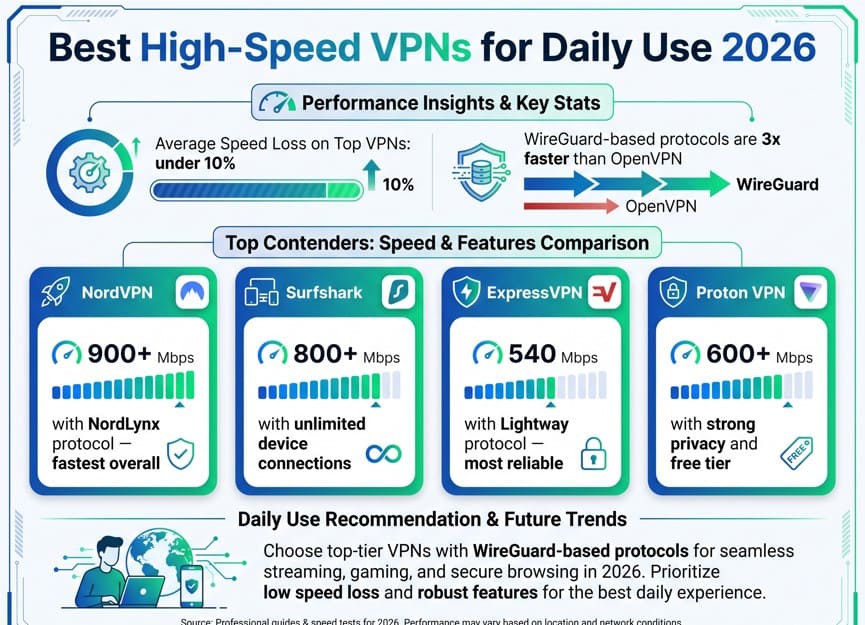
If you’ve ever watched a Netflix stream stutter, lost a ranked match to lag, or waited forever for a file to download, you already know speed matters. A VPN should protect your privacy without turning your gigabit connection into dial-up. The good news? In 2026, the top VPN providers have closed the speed gap dramatically — the best ones now keep over 90% of your original bandwidth.
This guide cuts through the marketing noise and tells you exactly which VPNs are worth your money for everyday browsing, streaming, gaming, and work.
Why Speed Matters for a Daily-Use VPN
A VPN encrypts your traffic and routes it through a remote server. That extra step always costs some speed — the question is how much. For casual browsing, you barely notice. But for 4K streaming, online gaming, or large downloads, every Mbps counts.
Here’s what speed actually impacts in daily life:
- Streaming quality — 4K needs at least 25 Mbps; buffering kills the experience
- Gaming ping — high latency over 80 ms makes competitive games unplayable
- Video calls — Zoom and Teams glitch when bandwidth dips below 10 Mbps
- Cloud work — uploading large files to Google Drive or Dropbox slows down
- Torrenting — P2P transfers benefit hugely from fast WireGuard-based protocols
Top High-Speed VPNs Compared (2026)
Based on the latest independent speed tests from PCMag, CNET, and Security.org, here are the four VPNs that consistently top the charts.
| VPN | Top Speed (Mbps) | Speed Loss | Best Protocol | Devices | Starting Price | Best For |
|---|---|---|---|---|---|---|
| NordVPN | 900+ | ~6% | NordLynx | 10 | $3.09/mo | Overall fastest, gaming, 4K streaming |
| Surfshark | 800+ | ~8% | WireGuard | Unlimited | $2.19/mo | Families, budget users |
| ExpressVPN | 540+ | ~10% | Lightway | 8 | $4.99/mo | Reliability, beginners |
| Proton VPN | 600+ | ~9% | WireGuard | 10 | Free / $4.99/mo | Privacy + free tier |
| IPVanish | 500+ | ~12% | WireGuard | Unlimited | $3.33/mo | Power users, US-based |
The Best Pick for Most People: NordVPN
If you want one short answer: NordVPN is the fastest VPN for daily use in 2026. PCMag awarded it their Lab Award for fastest VPN this year, and CNET confirmed it as the top performer in their tests. The reason is a proprietary protocol called NordLynx, built on WireGuard but tuned to keep speeds high without sacrificing privacy.
NordVPN runs more than 9,200 servers across 137 countries, which means a fast nearby server is almost always available. It also unblocks Netflix, Disney+, Hulu, BBC iPlayer, and most other streaming platforms without breaking a sweat.
Runner-Ups Worth Considering
Not everyone needs the absolute fastest VPN. Here’s when the alternatives make more sense:
- Choose Surfshark if you have a big household — it allows unlimited simultaneous connections and costs less than $2.50/month on long-term plans.
- Choose ExpressVPN if you want the most polished, beginner-friendly app with rock-solid uptime. Its Lightway protocol reconnects faster than most rivals.
- Choose Proton VPN if you care most about privacy — it’s based in Switzerland, audited, and offers a genuinely usable free tier.
- Choose IPVanish if you live in the US and want unlimited device connections at a mid-range price.
Key Statistics on VPN Speed in 2026
- Less than 10% speed loss on top-tier VPNs like NordVPN and Surfshark
- 3x faster — WireGuard-based protocols vs. legacy OpenVPN
- 903 Mbps — NordVPN’s average max recorded speed in 2026 testing
- 31% of internet users worldwide now use a VPN regularly
- Sub-50 ms ping achievable on nearby servers for most premium VPNs
How to Pick the Right High-Speed VPN: A Practical Guide
Don’t just buy the first VPN you see advertised. Walk through this checklist before subscribing:
- Check protocol support — make sure WireGuard, NordLynx, or Lightway is offered. Avoid VPNs that only support OpenVPN or PPTP.
- Look at server count near you — more nearby servers = lower ping and faster speeds.
- Verify a no-logs policy — ideally one that’s been independently audited (Deloitte, PwC, or Cure53).
- Test the money-back guarantee — most premium VPNs offer 30 days. Run your own speed tests during this window.
- Confirm streaming support — read recent reviews to make sure Netflix, Disney+, and your local streamers actually work.
- Check device limits — count every laptop, phone, tablet, smart TV, and router in your home.
- Prioritize features you’ll actually use — split tunneling, kill switch, multi-hop, ad blocking.
Quick Tips to Maximize Your VPN Speed
Even the fastest VPN can feel sluggish if you set it up poorly. Here’s how to get the most out of yours:
- Connect to the nearest server — distance to the server is the #1 speed factor
- Switch to WireGuard — most apps default to it now, but check your settings
- Use a wired Ethernet connection when possible instead of Wi-Fi
- Avoid obfuscated servers unless you actually need them — they’re slower
- Restart your router if speeds suddenly drop on a previously fast server
- Enable split tunneling so non-sensitive apps bypass the VPN
FAQ
Q: Will a VPN slow down my internet? Yes, but only slightly with a top-tier service. Premium VPNs like NordVPN and Surfshark cause less than 10% speed loss in most tests, which is unnoticeable for everyday tasks.
Q: Is a free VPN good enough for daily use? For light browsing, Proton VPN’s free tier is the only one I’d trust. Most other free VPNs have data caps, slow speeds, intrusive ads, or worse — they sell your data. For streaming or gaming, you need a paid plan.
Q: Which VPN protocol is the fastest? WireGuard and its variants (NordLynx, Lightway) are the fastest in 2026. They’re roughly three times faster than older OpenVPN connections while offering equal or better security.
Q: Can a VPN improve my gaming ping? Sometimes, yes. If your ISP throttles game traffic or routes your connection inefficiently, a VPN can actually lower ping. Otherwise, expect a small increase of 5–20 ms on a nearby server.
Q: Is it legal to use a VPN? In most countries, yes. VPNs are legal in the US, UK, EU, Canada, Australia, and most of Asia. They’re restricted or banned in places like China, Russia, Iran, and North Korea.
Q: How much should I pay for a good VPN? Expect $2–$5/month on a 2-year plan, or $10–$13/month if you go monthly. Anything cheaper is suspicious; anything more expensive is overpriced.
Q: Can I use one VPN account on multiple devices? Yes. NordVPN allows 10 devices, ExpressVPN 8, and Surfshark and IPVanish offer unlimited connections — ideal for families.
Q: Do VPNs work with Netflix and other streaming services? The premium VPNs in this guide all reliably unblock major streaming services. Free and low-quality VPNs usually get blocked within weeks.
The Bottom Line
For daily use in 2026, NordVPN is the best high-speed VPN overall — fast, reliable, secure, and reasonably priced. If budget is your main concern, Surfshark delivers nearly identical speeds for less. If you want the most user-friendly app, ExpressVPN is still the gold standard. And if privacy and a free option matter most, Proton VPN is the pick.
Whichever you choose, take advantage of the 30-day money-back guarantee and run your own speed tests during the trial period. Your real-world results matter more than any benchmark.
Sources: PCMag Fastest VPNs 2026 · CNET Best VPN 2026 · Security.org Speed Tests · Cloudwards VPN Comparison